
Our representative democracy is so archaic, it hasn’t represented the population’s will for a long time. We need to explore other systems of governance. Here’s a great example of a great one and you have to ask yourself why you haven’t heard of it before.
Which country would you guess leads the world in most billion-dollar startups per capita? Singapore, Israel, South Korea? All of these countries are doing well, but you’d still be wrong.
In first place, way ahead of everyone else, is a country you may not have even heard of. A country that was still part of the Soviet Union just 30 years ago — with basically no economy to speak of.
Today, despite being one of the smallest countries in Europe, it has more billion dollar start ups than much larger nations like Mexico, Poland, Indonesia — or even highly developed countries like the Netherlands.
This country is now widely considered to be the most digitalized in the world: Estonia.
But the most interesting part isn’t just that Estonia is successful — it’s how it got there.
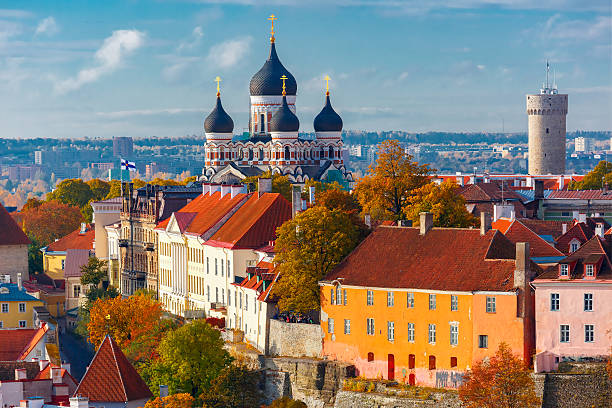
Toompea hill with tower Pikk Hermann and Russian Orthodox Alexander Nevsky Cathedral, view from the tower of St. Olaf church, Tallinn, Estonia
How do you take a country from scratch to a tech hub in just 30 years?
In Estonia’s case, this wasn’t an accident. It was the result of a visionary strategy. The country itself was built like a startup: bold, radical decisions, an obsessive focus on one goal, and a willingness to do things differently than everyone else.
So how did Estonia become Europe’s startup nation? What exactly are they doing differently?
Estonia’s journey started with hardship. After World War II, the country was annexed by the Soviet Union and became a cog in the communist machine. For decades, it was reduced to extracting natural resources for the USSR. By the time it regained independence in 1991, its economy was in ruins — centrally planned, mismanaged, and outdated.
So how did it turn into a tech powerhouse?
There are three major reasons behind Estonia’s success:
1. Visionary Alignment with the Nordics
Estonia has always been culturally close to the Nordics, especially Finland. So when independence came, it looked north for inspiration. But Estonia also realized it couldn’t catch up by taking the traditional route. Heavy industry, cheap labor, and outdated infrastructure wouldn’t close the gap.
So instead, Estonia chose a bold path: focus entirely on emerging technology. It bet the farm on becoming a digital nation.
2. Invest in Human Capital — Starting with Education
With few resources and little industry, Estonia turned inward — investing in its people. In 1996, it launched the Tiger Leap program to overhaul its education system.
- Even though half the country didn’t have phones in 1991, by the year 2000 every school had internet and computers.
- By 2012, Estonia became the first country to teach coding to elementary school children.
- They partnered with education pioneers to revolutionize math instruction — not just teaching equations, but problem-solving and computational thinking.
- Crucially, they made everything from textbooks to school lunches free, ensuring equity and access across the population.
The result? In 2022, Estonian students outperformed every other country in Europe in math, science, and reading — and ranked in the top 8 worldwide, alongside Singapore and South Korea. And they did it while spending significantly less per student than wealthier nations.
3. Build the Infrastructure for Digital-First Business
While training generations of tech-savvy citizens, Estonia also made starting and running a business incredibly easy.
- Taxes have been fully online since the year 2000.
- Digital IDs were rolled out in 2001.
- Online voting began in 2005.
- Legal signatures went digital in 2002.
- You can apply for marriage online as of 2022.
By the end of 2025, Estonia plans to be the first country with a 100% digital government. Every citizen interaction can be done online, with full data transparency.
Starting a business takes just 15 minutes. Estonia even offers e-residency — letting foreign entrepreneurs open companies there without setting foot in the country, paying a flat 20% corporate tax.
But there was still one challenge: market size.
With just over a million people, Estonia is smaller than Brooklyn, NY. So instead of focusing on domestic markets, Estonian entrepreneurs are forced to think globally from day one.
Where other countries build medium-sized businesses that stay confined, Estonians build to scale internationally — because they have to. As locals say, “Estonia isn’t your market — it’s your accelerator.”
So what do you get when you combine:
- A bold government willing to innovate like a startup
- A STEM-focused, digitally fluent population
- An all-digital infrastructure
- And a necessity to scale globally?
You get Skype, Bolt, Wise, and many more unicorns — and the youngest billionaire in Europe, an Estonian tech founder.
Estonia’s rise wasn’t a miracle. It was a blueprint for success
