
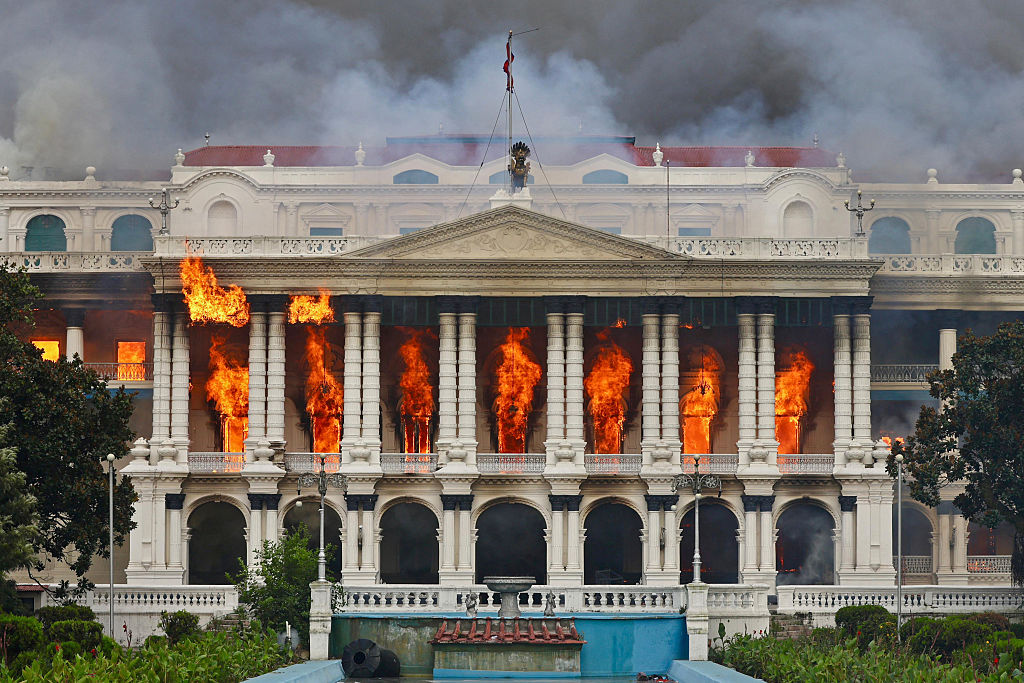
TOPSHOT – CORRECTION / Fire rages through the Singha Durbar, the main administrative building for the Nepal government, in Kathmandu on September 9, 2025, a day after a police crackdown on demonstrations over social media prohibitions and corruption by the government. Nepali youth protesters set fire to parliament on September 9 as the veteran prime minister obeyed furious crowds to quit, a day after one of the deadliest crackdowns in years in which at least 19 people were killed. (Photo by Prabin RANABHAT / AFP) / “The erroneous mention[s] appearing in the metadata of this photo by Anup OJHA has been modified in AFP systems in the following manner: [Byline – Prabin RANABHAT] instead of [Byline – Anup OJHA]. Please immediately remove the erroneous mention[s] from all your online services and delete it (them) from your servers. If you have been authorized by AFP to distribute it (them) to third parties, please ensure that the same actions are carried out by them. Failure to promptly comply with these instructions will entail liability on your part for any continued or post notification usage. Therefore we thank you very much for all your attention and prompt action. We are sorry for the inconvenience this notification may cause and remain at your disposal for any further information you may require.” (Photo by PRABIN RANABHAT/AFP via Getty Images)
Officials claimed this was to regulate online platforms, prevent “misinformation,” and enforce accountability. But to the public, it was clearly an attempt to silence dissent.
What most people don’t know is why it happened. The government’s move didn’t come out of nowhere — it followed the discovery that Nepal’s youth were coordinating online to organize protests and discuss reform.
In response, activists quickly migrated to Discord and alternative apps like Viber and TikTok. These became hubs for coordination, tactical planning, and even digital “mini-elections” to nominate interim leaders.
How They Organized
- No central leader: The movement was decentralized, focused on transparency and anti-corruption.
- Polling and deliberation: Discord servers hosted over 100,000 participants debating and voting — eventually nominating Sushila Karki as an interim figure.
- Tactical evasion: QR-coded flyers and VPNs helped organizers bypass government censorship.
They built what can only be described as a digital agora — a spontaneous, consensus-driven experiment in online governance.
The Broader Pattern
We’ve seen this before. During the pandemic, global elites used the crisis to condition populations for control through vaccine passports — a test run for Digital ID systems. The same pattern is repeating now:
- suppress communication,
- centralize control,
- tie digital identity to taxation and financial access.
Examples from around the world show how populations react:
- Nigeria: Low digital ID adoption led the government to destroy its own currency to force compliance.
- Vietnam: Account freezes revealed widespread public resistance.
- Canada: Simple incentives like “instant tax refunds” would likely drive 80–90% compliance overnight.
The youth in Nepal, however, flipped the script. When their government tried to silence them, they built their own digital infrastructure to communicate, organize, and lead.
Forecasting the Future
Future forecasting is about tracing the logical evolution of technology and society — essentially, anthropology projected forward.
The rise of digital governance is inevitable, but it doesn’t have to mean tyranny. If directed properly, it can serve freedom instead of control.
History shows how free-market disruption can topple centralized power:
- Netflix destroyed Blockbuster.
- Airbnb and Uber disrupted entrenched industries.
- Even the Chinese Communist Party lifted millions from poverty only after adopting limited market principles.
Technology, when not monopolized by state or corporate parasites, can liberate. We are transitioning from representative systems of the agricultural age to technological self-governance suited for the information era.
The Digital Battlefield
Control over information and financial systems equals control over people. The ruling class knows that losing either means losing power.
We must distinguish between digitization that erodes liberty and digitization that strengthens freedom.
Technology cannot be stopped — but it can be redirected. We must resist centralization and ensure technology serves human freedom, not enslavement.
Since the dawn of personal computers, liberty-minded programmers have been developing ways to secure our freedoms digitally.
The foundational principle remains: “Privacy is necessary for an open society in the electronic age.”
As communication moves online, individuals must protect their privacy through cryptography, not government promises.
Main Principles
- Privacy is not secrecy: Private matters are selectively shared, not shameful.
- Encryption is a tool of freedom: Strong cryptography allows communication and trade without surveillance or censorship.
- Governments and corporations cannot be trusted: Individuals must build their own privacy tools.
- Code is activism: Writing and sharing cryptographic software is a political act — a defense of human rights in the digital era.
This framework safeguards liberty and privacy. Representative governance is outdated — like using a washboard to do laundry. Parasites gravitate toward it because it feeds their hunger for power and control.
Toward Direct Democracy
What we need is direct democracy, similar to Switzerland’s model. Countries like Taiwan and Uruguay already allow citizens to vote in public referendums online.
These nations share key traits:
- Resistance to UN-driven mass migration.
- High levels of personal wealth and safety.
- Switzerland’s high gun ownership with low crime.
- Estonia’s leadership in billion-dollar startups per capita.
The Money Fraud
Paper fiat currency is the biggest fraud in history. It funds corruption and gives elites total control. As Mayer Amschel Rothschild said: “Give me control of a nation’s money supply, and I care not who makes its laws.”
When the U.S. became the world’s reserve currency, dollars were once redeemable for gold. But on August 15, 1971, President Richard Nixon ended that convertibility, creating a fiat system backed only by government credit.
From that moment, the U.S. began printing unchecked currency — birthing the age of inflation and global financial manipulation. Most people in finance remain unaware of this ongoing fraud.
Every world reserve currency in history eventually collapses. This one is past its shelf life. Cash has become a tool of economic enslavement. The uncontrolled money supply breeds corruption and destroys purchasing power.
Since 2020, more currency has been created than in all previous U.S. history combined. Clinging to paper money is like holding onto the hull of a sinking ship.
The growing awareness of this fraud marks the next phase of global awakening. Alternatives must be sought.
Adapting to What’s Coming
Barter might sustain survival, but it’s impractical in a collapsing, unstable society. When the grid fails, it takes only three days for the average person to turn to crime. You won’t be driving around with chickens and buttons to trade.
The middle class will continue to erode, and it will become nearly impossible to reach the upper class without the ability to transfer value electronically.
This brings us back to the core truth: We can’t survive if we don’t keep up with technology.
The elites exploit public ignorance and apathy toward tech to weaponize it against us. Never forget — we are in a technological arms race against those who seek to erase personal freedom.
